Just in time for ski season comes this week’s most expensive new listing on realtor.com®. A magnificent mountain retreat in Vail, CO, has landed on the market for $32 million.
Judging from photos of the home from when it was sold for $14.5 million in 2014, the current owner has rebuilt the home and created a sleek and modern showpiece.
The luxe residence did have a dalliance with the market about a year ago for $32.5 million, and was relisted just this week with the slight drop in price. For buyers unable to part with that kind of money for a vacation spot, it’s also been available as a short-term rental, with prices around $22,000 a night.
Given its location in a popular upscale ski destination, keeping it on the vacation rental market would be an excellent use of a place that owners might use only a handful of times a year.
The property itself is an ultramodern option for the ski set, and is billed as “the most extraordinary home in Vail” in the listing.
Decks with Vail Village and mountain views
realtor.com
Dining room
realtor.com
Bedroom
realtor.com
Indoor pool
realtor.com
Home theater
realtor.com
Outdoor pool and patio
realtor.com
The 8,559-square-foot home has seven bedrooms and seven bathrooms. The stone, wood, and glass building features walls of windows, and the main floor features a dining area, living area, and adjacent kitchen.
The home boasts an indoor lap pool, as well as an outdoor pool and hot tub. The deck measures 2,769 square feet and offers dramatic views of Vail Village and Gore Range. Otherperks include a home theater, gym, two outdoor fireplaces and a grill area, as well as a patio with a fire pit.
Vail Village is just a short walk away and offers shops and restaurants.
The property was purchased in 1998 for $9 million by Texas businessman Bill Dore, according to the Vail Daily. After sinking “millions” into improvements, the Dore family eventually placed the home on the market in 2006 for $21 million. That asking price, the highest ever in Vail at the time, attracted plenty of attention over a decade ago.
In 2007, with no change in price, the home made local headlines again, for staging a high-end fashion show in the hopes of attracting a buyer. The stylish ploy didn’t work—according to real estate records, the home didn’t change hands until 2014.
Now once again, the vacation nirvana finds itself on the market, with another ambitious bump in price.
Eustaquio Cortina with Ron Byrne & Associates holds the listing.
Editor's Note: The expensive coastal cities' current housing affordability crisis has been decades in the making, the result of slowing metropolitan growth in the face of sustained housing demand. This piece explores the historical housing development patterns in a series of different metros nationwide,and illustrates how each is representative of larger groups of similar markets. For a deeper dive into potential new housing that could be developed under a variety of densification scenarios should current restrictions on density be relaxed, we encourage you to read our additional research here.
There are currently almost 140 million homes in the United States, and analyzing where, when and how they were built tells a vivid story of America's metropolitan growth. But more than a history lesson, having a clear view of our past development patterns is vital for understanding the causes of our current housing affordability issues, and for shaping effective solutions.
Cities and metro areas grow in two ways: By expanding outward into the surrounding, undeveloped countryside; and/or by growing denser within an already-developed footprint. Historically, American cities have done both. But since the 1970s, several of the country's most economically vibrant coastal cities have gradually been doing less and less of either. The result has been decades of faster-than-average housing price growth in these areas as they've struggled to add sufficient new housing in the face of sustained housing demand, which underpins their current housing affordability crisis.
Additionally, residential development in essentially all American metros has shifted to a new pattern. Construction in metropolitan interiors now concentrates in clusters of very large apartment buildings, dispersed amid mature, less-densely developed suburban tracts that are virtually frozen in time and produce almost no new housing. There is enormous potential for new housing supply to be had by allowing for even modest amounts of new density – allowing a small share of lots currently host to a single-family home to instead house two, three or four units – in these otherwise stagnant areas.
Mapping Growth
The following maps allow us to visualize the growth of large U.S. metros over the past 80-odd years, detailing what type of housing has been built, where and when over the decades.
Here's how to interpret these visualizations:
The colors reflect the mixture of housing types: Single-family homes in blue; small and medium-sized apartment buildings (2 to 49 units) in yellow; and large apartment buildings (50 units or more) in red.
The degree of transparency corresponds to housing density – more transparent means less dense, more opaque means more dense
Note: When viewing housing from a specific timeframe, e.g. from 1960-1980, the map will appear more transparent because the opacity corresponds only to the incremental housing density built during that period. Viewing multiple vintages overlays the transparencies, illustrating how certain areas have become gradually more dense over time.
Select a metro area to see how its housing stock has evolved:
With these visualizations in mind we can consider how three very different metropolitan regions have grown over time, and illustrate how each is representative of larger groups of similar regions.
Los Angeles
The Los Angeles region expanded into the surrounding countryside very quickly in the second half of the 20th century, but its pace of expansion substantially slowed after the 1980s. From 1940 to 1990 the region's developed footprint expanded by 406 square miles per decade, on average. From 1990 to 2010 it expanded only 215 square miles per decade (and the pace in the 2010s has likely been even slower).
Densification – adding more homes to already-developed areas – was common as recently as the 1980s and '90s, often taking the form of small and medium-sized apartment buildings (2 to 49 units). But densification has largely tapered off, with most of the L.A. metro's interior producing very little new housing. Residential construction in the interior is now increasingly concentrated in clusters of very large apartment buildings (50+ units). The visual signature of L.A.'s development pattern over the most recent 20 years – most aptly described as islands of density in a sea of no-growth – is a transparent metropolitan interior speckled with small clusters of red.
L.A.'s development pattern is typical of west coast metros including the San Francisco Bay Area, Portland, Seattle and San Diego. To a lesser extent, the Los Angeles region's metropolitan growth also resembles that of metros in the northeast, including New York, Boston, and Washington.
Houston
The Houston region also expanded into the surrounding countryside very quickly in the second half of the 20th century. But unlike the Los Angeles region, Greater Houston's expansion has not slowed down.
Because the region has accommodated new residents largely through outward expansion, there has been less buildup of demand for housing within the developed footprint, and therefore less densification than in L.A. and other areas. Indeed, the region's outward expansion has provided a relative abundance of housing that has helped keep affordability in check and house prices themselves largely tethered to the cost of construction rather than just people's willingness to pay.
Still, some popular areas in Houston's metropolitan interior have seen substantial densification. Although it's relatively easy for the metro as a whole to expand outward, areas within it are "landlocked" by surrounding developed areas – leaving growth through densification as their only option. When demand for living in these specific areas rises, they can only grow denser and/or more expensive.
As elsewhere, densification within Houston's already-developed area has also gradually taken on the islands of density pattern.
The Houston region is typical of other growing and affordable metros in the south, including Atlanta, Austin, Dallas, Phoenix and Raleigh. To a lesser extent, it also resembles some metros in other parts of the country experiencing growth pressures but also surrounded by plenty of open land, such as Minneapolis, Denver and Sacramento.
Detroit
Detroit has had its share of troubles, but even so its developed footprint continues to expand. Still, the pace of that growth is modest compared to a place like Houston – or even Detroit's own historical growth.
Given the lack of constraints on the region's outward expansion, as well as the relatively weak demand for living there, the Detroit region's metropolitan interior has experienced little densification. But again, as in other parts of the country, the densification that has occurred in recent years has shifted towards the islands of density pattern.
The Detroit region is typical of other Rust Belt metros including Buffalo, Cleveland, Milwaukee and St. Louis. To a lesser extent, it is also reflective of the Pittsburgh region and parts of the Philadelphia and Chicago metros.
Islands of Density in a Sea of No-Growth
Because of local rules and regulations that have accrued over the decades, it is rare today to see the nation's low-density suburban tracts redeveloped more densely. Areas zoned for single-family homes are particularly well-insulated from such change, and rarely see the types of multifamily construction common as recently as a generation ago. Such areas account for most of metropolitan America's land, and comprise the sea of no-growth.
That sea is punctuated by islands of density, almost the only places in which densification still occurs today. They consist of clusters of very large apartment buildings (50+ units), and they typically emerge in areas including:
Suburban downtowns, where density is grandfathered in
Near transit, where the case for density is most compelling
Formerly non-residential areas where their development draws less local opposition.
The Future
As America struggles with a housing affordability crisis, especially in the expensive coastal cities, reinvigorating outward expansion – in other words, sprawl – is generally regarded as unsustainable. This leaves densification as the main alternative.[1]
That raises an important question. Should densification be confined to islands of density, as it is today, or should American cities also come to accept modest densification of the vast existing sea of no-growth? The two options are complementary, not mutually exclusive, and pursuing them jointly could allow cities to produce a greater number of homes and a richer mix of housing types than they could otherwise.
………………..
Data & Methodology
The data presented in the maps are drawn from the 2013-2017 5-year compilation of the American Community Survey and reflect the existing housing stock as of that period. For more information on the advantages and disadvantages of using the current stock of existing homes to indirectly observe past patterns of metropolitan growth, see the data and methodology sections of the first two studies in the Further Reading section.
The areas represented in the maps are U.S. Census tracts, and the extent covered by each map is determined by the current definition of the metro area, which is either a CBSA or a CSA where one exists. Tract hue is determined as a linear combination of the number of the number of housing units built during a period in each of the three structure size categories: Single-family, 2-49 unit and 50+ unit structures. Tract opacity is determined by the incremental housing density built during each period, which is subjected to the following transformation: opacity(x) = k -1log(1+x), where x denotes incremental housing density (in terms of homes per acre) for one or more periods and k= log(1+max{x}), where max{x} is the maximum observed cumulative density for the entire timespan across all Census tracts in the pool of metro areas mapped. The transformation maps into the range [0,1] and is monotonic. It ensures that virtually all tracts are partially transparent given any combination of displayed time periods. Only for periods during which incremental housing density was strictly zero is a tract be fully transparent, and only a single tract whose cumulative housing density across all periods is the national maximum is fully opaque when all time periods are displayed concurrently.
[1] Another alternative is embracing smaller homes, as espoused by the movement around tiny homes and micro-units, but that appears to be a niche trend.
Five years ago, the mansion known as Palazzo di Amore was priced at $195 million, which made it the most expensive home in the United States.
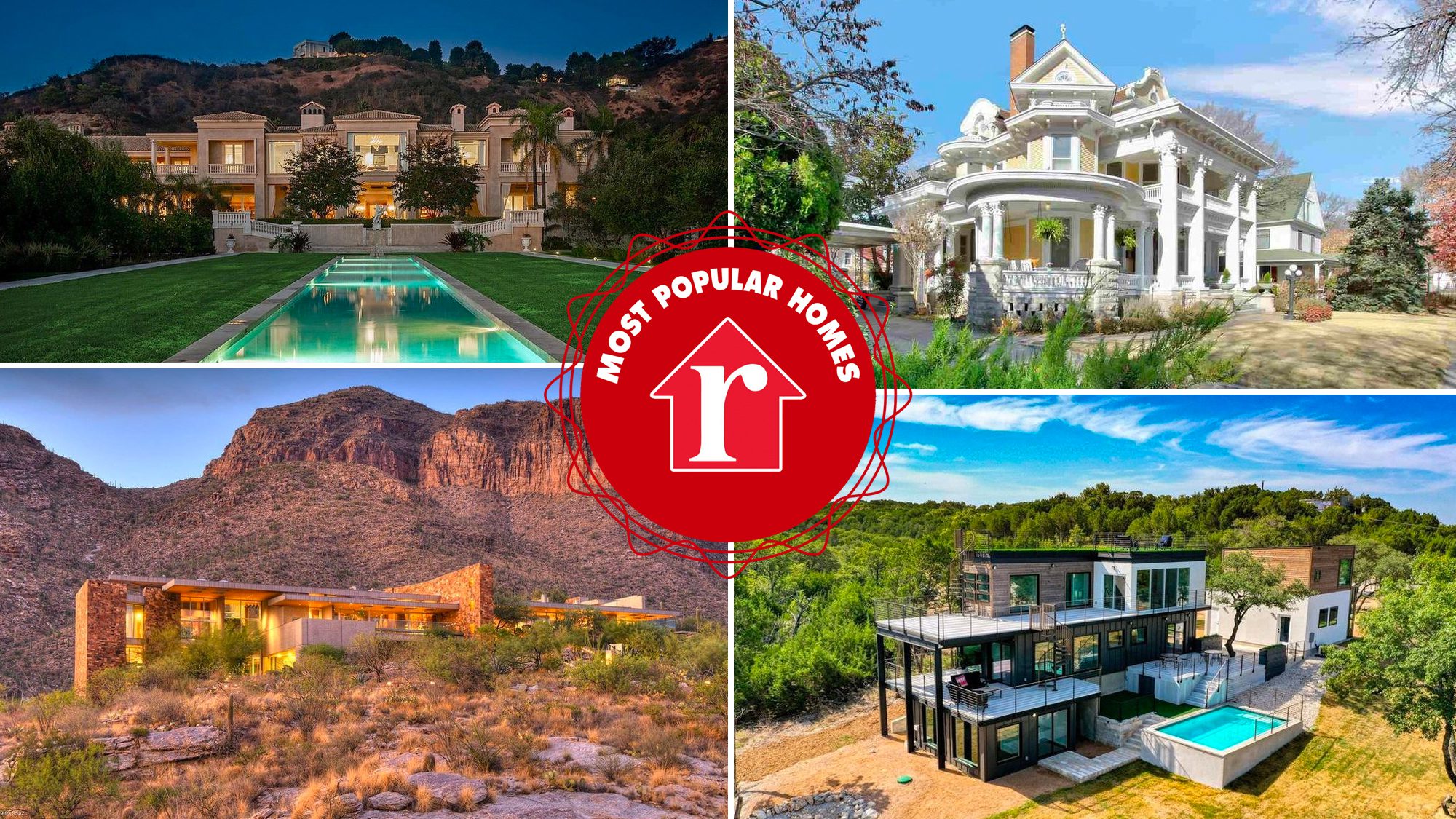
Now, the 25-acre compound in Beverly Hills, CA, is back on the market for $129 million (again!), and its regal return created a whole lot of clicks. The massive mansion took the title of this week’s most popular home on realtor.com®.
Lottery lovers must be filling out their 2020 vision boards with photos of this herculean homestead, because with a nine-digit price tag, it’s the kind of place only billionaires can truly afford.
Will this renewed interest finally attract a buyer? For the richest 1% in need of 50,000 square feet of living space, it feels like it’s finally time to fall in love with Amore.
Besides Beverly Hills luxury, you also clicked on a dreamy, 25,000-square-foot desert mountain retreat in Arizona, a cute and quirky shipping container house designed for lakeside fun, and the Arkansas mansion of the recently fired Razorbacks football coach Chad Morris.
We won’t ask you to scrounge up $129 million, but we would like you to take a look at this week’s most popular homes…
Price: $1,300,000 Why it’s here: Sitting on more than 17.5 acres, this large country property was once owned by Henry Morgenthau Jr.—the secretary of the Treasury under Franklin Delano Roosevelt. The nine-bedroom main house could easily be converted into a bed and breakfast or kept as a single-family residence. Surrounded by an additional 240 acres of protected forest, the home could also make a wonderful equestrian property. There’s even a an old 2,100-square-foot barn, with stalls, a hayloft, and a two-bedroom apartment.
Price: $9,900,000 Why it’s here: This ultraprivate desert mountain retreat sits at the edge of more than a million acres of protected land. Located behind a guard gate, the secluded mansion is only minutes away from shopping and dining in the desert. The seven-bedroom, 25,000-square-foot home is known as Campbell Cliffs, and includes luxe amenities like a two-story gym, tennis court, and pool.
Price: $675,000 Why it’s here: Our recent look at shipping container homes yielded this striking place—a lake house with three separate units that all share a pool. They can be rented out for additional income or used as a retreat for a large group. Dubbed the Villa de Shipping Containers, this one-of-a-kind residence is close to Lake Travis and offers multiple patios where you can soak in the natural beauty of the Texas Hill Country.
Price: $149,900 Why it’s here: This charming and historic Arts and Crafts bungalow was built in 1904. Original features of the three-bedroom home, like the hardwood floors, woodwork, and chandeliers, have been preserved. Updates like the rehabbed wraparound porch and new kitchen have helped make this a place for a 21st-century buyer.
Price: $424,900 Why it’s here: Currently known as the Hickory Haven Inn at Balsam Mountain, this 6,000-square-foot residence was built in 1912. Tucked among tall trees in a private, secluded forest, it can be used as a rental on Airbnb or a single-family home. Sitting on over 3 acres, with views of the Blue Ridge Mountains, the home boasts two full kitchens, a game room, several dining rooms, three fireplaces, and a whole-house generator.
Price: $349,000 Why it’s here: This historic Federal-style brick home was built in 1871 by Judge Richard Seal on a hill overlooking this town along the Mississippi River. The four-bedroom home still has its original pine floors and chandeliers, but has been extensively updated and renovated, making it a move-in ready choice.
Price: $3,799,000 Why it’s here: College football’s annual coaching carousel has already started spinning! This custom home is being sold by fired Arkansas Razorbacks football coach Chad Morris. Built in 2010, the 3-acre estate has a seven-bedroom main house and a one-bedroom guesthouse. There’s also plenty of room for outdoor entertaining, with patios, pool and spa, fire pit, and heated sport court. Morris put it on the market less than a month after getting the ax, and his quick action seems to have paid off—the home’s now pending sale.
Price: $3,500,000 Why it’s here: Billed as a “sportsman’s paradise,” this spread was designed for hunting and fishing. There’s a six-bedroom home on the property, but the true highlights are for folks who know their way around a firearm. The 468-acre property features a rifle range, numerous deer stands, and “some of the largest whitetail bucks in the continental U.S.” And if it’s not deer season, there’s also a 10-acre private lake stocked with a variety of fish.
Price: $339,000 Why it’s here: Sitting in the city’s Fairview Historic District, this classic home from 1909 is known as the Wey mansion. It’s a riotous neoclassical revival acknowledged by the Kansas Heritage Grant Foundation as an “exceptional example of its style and period.” The property includes a two-story main house and a carriage house, the latter currently being used as a garage.
Price: $129,000,000 Why it’s here: Once the most expensive listing in the country, this 25-acre compound in 90210 was built on a scale most resorts would envy. Dubbed Palazzo di Amore, the Mediterranean-style retreat includes 50,000 square feet of living space, a 10,000-bottle wine cellar, Turkish-style spa, and an entertainment complex complete with bowling alley, theater ballroom—and, perhaps needless to say, a disco. It also includes a guesthouse, tennis court, formal gardens, pool, and 12-car garage.
The coming year’s hottest shade isn’t actually hot at all. Nope, it’s the calm, cool Classic Blue—Pantone’s much anticipated 2020 Color of the Year.
Leatrice Eisman, executive director of the Pantone Color Institute, says this solid, still waters-run-deep hue was selected because of—wait for it—the global need for stability.
“We’re living in a time that requires trust and faith, and it’s this kind of constancy and confidence that is expressed by Pantone’s 19-4052 Classic Blue, a solid and dependable blue we can rely on,” she explains. So maybe chalk up all the White House drama and climate change woes for our need to embrace this honest, relatable tone.
And for the first time this year, Pantone’s Color of the Year isn’t just one that can be seen, but heard, felt, and tasted, too: To coincide with this major color announcement, Pantone is releasing a free track inspired by Classic Blue called “Vivid Nostalgia” (developed by audio branding agency Audio UX), as well as for-purchase, color-coordinated berry tea and fabric.
Although Pantone’s Color of the Year is always met with fanfare, this year’s hue seems to be surrounded by a lot more hubbub than usual. And other color experts agree that blue is having a moment.
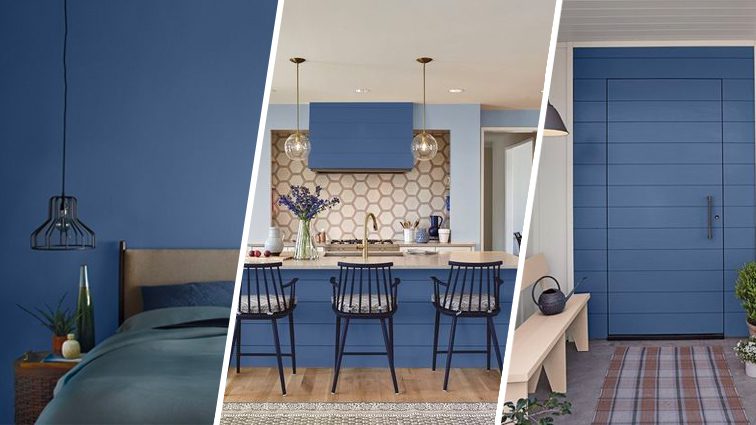
“Blue is not only trending, but it’ll stand the test of time—and now that many people are looking to nature for inspiration, we’re seeing a full range of blues bubble up,” notes ErikaWoelfel, vice president of color and creative services at Behr Paint, whose hue Optimum Blue M540-7 is deemed the closest color match for all of your 2020 home projects.
Want to work this color into your home decor? Check out these gorgeous ways to embrace 2020’s cool blue hue.
Front door
If you’re into feng shui, blue is said to channel peace and a sense of calm. Blue also represents water in feng shui, and it’s an ideal shade if you’re a coastal homeowner, so try a coat on your front door.
Homeowners with blue doors are said to be more trustworthy (who knew?).
Behr
Kitchen island
A fresh coat of blue on your kitchen island is a cheery addition to a more typical beige palette. And this blue can help hide scuff marks when your kids kick the island from their perches.
A blue kitchen island and stove hood mean serene dinners every night.
Behr
Bedroom
For a good night’s sleep, think blue (there’s a reason more bedrooms aren’t painted orange or red). Blue is restful, and the shade has even been shown to slow heart rate and respiration. Sweet dreams!
Tuck in between the sheets in a moody blue boudoir, and dreamland is minutes away.
Behr
Accent wall
Create a fun contrast with an accent wall or half-wall. By painting this way, you’re adding visual interest to your room and mimicking a chair rail or wainscoting with just a little bit of paint.
Highlight your walls with a splash of blue on the lower level.
Behr
Bathroom vanity
Refresh your loo with some cool blue on your bathroom vanity. This blue pops beautifully against walls in a shade of clay and a graphic black and white rug.
The median age of U.S. home buyers is now 47, according to the data compiled by Deutsche Bank. In 1981, the median age of American home buyers was 31.
Notably, the median age has increased by eight years since the financial crisis. Much of this rise can be attributed to the disappearance of young, first-time home buyers from the housing market.
Chart
Handout
In larger U.S. cities that have proved more popular with today’s young adults, home prices have skyrocketed. Inventory is a significant challenge: Baby boomers are increasingly choosing to age in place, while home builders have focused primarily on the upper end of the market since the Great Recession.
That’s left few entry-level homes available for younger people to buy.
The average annual income of home buyers has increased to over $93,000 in the wake of the affordability crisis, according to the National Association of Realtors. That’s well above the national median income of $61,937.
Younger adults are also struggling under the weight of student debt. A 2017 study from the National Association of Realtors and education-financing nonprofit American Student Assistance found that 83% of non-home owners said they believe that student-loan debt has delayed them from buying a home.
That figure was higher among the older cohort of millennials who were born between 1980 and 1989. That same report indicated that student debt was causing millennials to delay home ownership by a median of seven years.
And those heavy debt loads can make it more difficult to get a mortgage for a home. “No one talks about this anymore, but it’s still really hard to get a mortgage,” said Nela Richardson, investment strategist at Edward Jones. “You need to have pristine credit.”
Other factors are also at hand beyond the financial. Millennials have delayed marriage and having kids, for instance, which are milestones that tend to lead to people buying homes.
Matters may, however, improve in the years to come. TransUnion has predicted that at least 8.3 million first-time home buyers will enter the mortgage market between 2020 and 2022, thanks in part to low unemployment, low mortgage rates and rising wages.
And research has suggested that the demand to own a home remains extremely high among Generation Z, the generation that follows millennials.
One homeowner’s misfortune is another savvy home buyer’s opportunity.
Foreclosed homes are a way to snap up properties at a deep discount—particularly when it comes to luxury residences.
And for buyers looking to dive into the deep end of bank-owned homes, there are quite a few repossessed megamansions on the market.
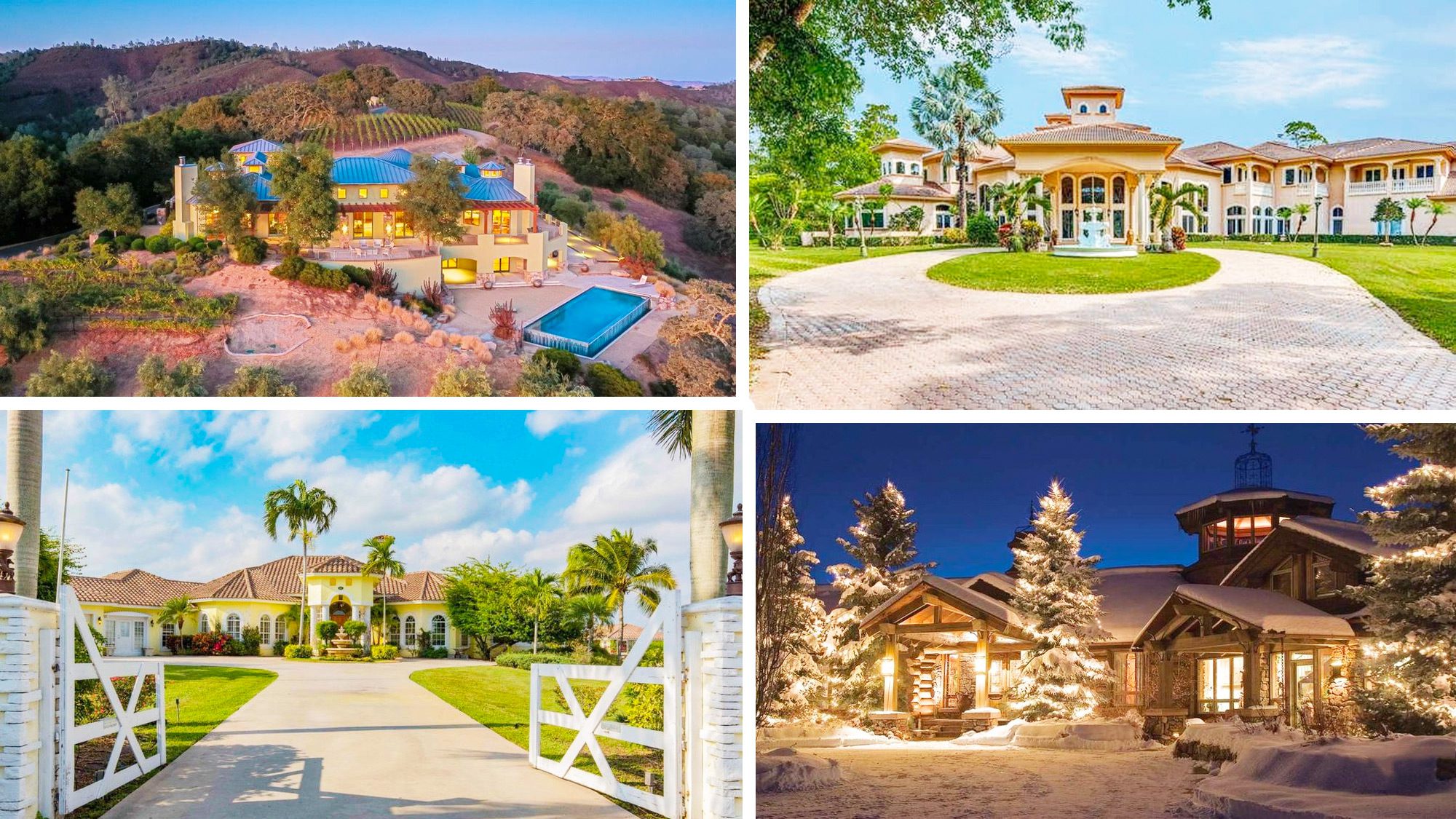
We’ve rounded up a list of the 10 most expensive foreclosures in the country. It’s a dizzying collection of over-the-top properties looking for a buyer interested in living large and scoring a sweet discount at the same time.
There’s a 117-acre vineyard estate listed for $650,000 less than its $7 million purchase price in 2012; a 15,000-square-foot retreat in Idaho available for $1.5 million less than its 2017 price tag; and a rambling ranch in Julian, CA, listed for about a half-million dollars less than its 2000 purchase price.
Think of it like Black Friday for high-end real estate—without the crowds. Enjoy!
Price: $6,350,000 Vineyard estate: Fancy yourself a winemaker? Built in 2006, this Tuscan-style vineyard estate spans more than 117 acres, which include a vineyard with cabernet grapes and olive trees. The resortlike grounds feature a zero-edge pool, terraces, bocce court, and outdoor fireplace. The 5,400-square-foot main house has two bedrooms and 3.5 bathrooms. It features views of Lake Hennessey and the Howell Mountains.
Price: $4,995,000 Equestrian, interrupted: Horse lovers will swoon for this South Florida mansion. Built in 2002, this five-bedroom home sits on more than 5 acres and features a heated pool and covered patio. A brand-new, 11-stall barn is under construction, complete with a viewing lounge and two apartments—it’ll need to be taken to the finish line by a new owner.
Price: $3,989,000 Boca acreage: This 16-bedroom mansion offers nearly 25,000 square feet of living space. It was built in 2002 and is being sold as is. The 5-acre property also comes with a guesthouse with attached rec room, commercial-size pool, and spa.
Price: $3,750,000 Mod & marvelous: This brand-new, four-bedroom home features porcelain floors, pocket doors and walls, and courtyards. There’s also a home theater, glass wine room, and jaw-dropping infinity pool.
Price: $2,995,000 Remodeled Tuscan: Featuring desert mountain views, this five-bedroom home has been remodeled with the finest finishes. Upstairs bedrooms come with balconies. The owner’s suite is a lavish affair with his-and-her bathrooms and closets and a separate sitting area. Outside, the home has large patios, a beautiful pool, sport court, and batting cage.
Price: $2,913,500 Log castle: This luxurious lodge measures 15,400 square feet and has 11 bedrooms and 15.5 bathrooms. Close to Sun Valley, it’s an ideal destination for corporate retreats or a heavy hitter in the media biz. Built in 1991, the home sits on more than 4 wooded acres.
Price: $2,750,000 Julian ranch: Originally built in 1933, the gated 206-acre ranch’s main house offers over 4,200 square feet of living space. The acreage is filled with apple and pear orchards, meadows, and horse corrals. There’s also a three-bedroom house for a caretaker, a one-bedroom trapper’s cottage, three barns, a storage shed, and root cellar.
Price: $2,500,000 Tropical estate: Sitting on the Gulf of Mexico with private sandy beaches and lagoon, this property is designed for fun in the sun. Built in 1958, the six-bedroom main house has plenty of room for friends and family. Outside, guests can enjoy the tropical pool with waterfalls, grill, covered boathouse, and deep-water dock.
Price: $2,500,000 Remodeled ranch: Built in 2004, this six-bedroom home recently received an extensive remodel. From the large kitchen to the “teen room” hangout, there’s something for everyone on this custom property. The backyard resembles a resort with a pool, an 800-square-foot guest casita, and entertaining areas.
Price: $2,365,000 Custom luxe: Sitting behind a guarded gate in the MacDonald Highlands neighborhood, this custom estate was built in 2008. The grand entry, sunken living room, and oversize windows offer drama. Features like the elevator and an owner’s suite with fireplace and balcony are all about comfort and convenience.